
This Is the Moment Everything Changes
Stop whatever you're building and pay attention. Multi-agent tool orchestration — the idea that a fleet of specialized AI agents can hand tasks to each other, call external tools autonomously, and complete end-to-end workflows without a human touching a keyboard — has crossed the line from research demo to production reality in the last 90 days. The engineers who internalize this shift now will own the next two years. Everyone else will be catching up.
The catalyst isn't a single model release. It's the convergence of three things happening simultaneously: the Model Context Protocol (MCP) reaching critical adoption mass, long-context models finally being cheap enough to use as orchestrators, and tool-calling reliability crossing the ~95% threshold that makes autonomous pipelines practical. When all three hit at once, the architecture unlocks.
Why This Is Blowing Up Right Now
Here's the hard data you need to internalize: tool-calling API requests across major providers grew over 400% in Q1 2026. The number of publicly listed MCP servers jumped from roughly 200 to over 3,000 in six months. Enterprise teams that were running single-agent pilots in late 2025 are deploying 10–30 agent topologies today.
The specific trigger was reliability. Early agentic systems failed because a single bad tool call would corrupt the entire run. Modern orchestration frameworks now support:
- Retry-with-reflection: an agent examines its own failed call and reformulates before escalating
- Speculative execution: parallel sub-agents run competing approaches; the orchestrator picks the winner
- Typed tool schemas: MCP-compliant tools return structured outputs the orchestrator can validate before passing downstream
The result is pipelines that actually finish. That's new. And it's why every team with a CI/CD budget is now asking "what can we hand to agents?"
The Architecture That's Winning
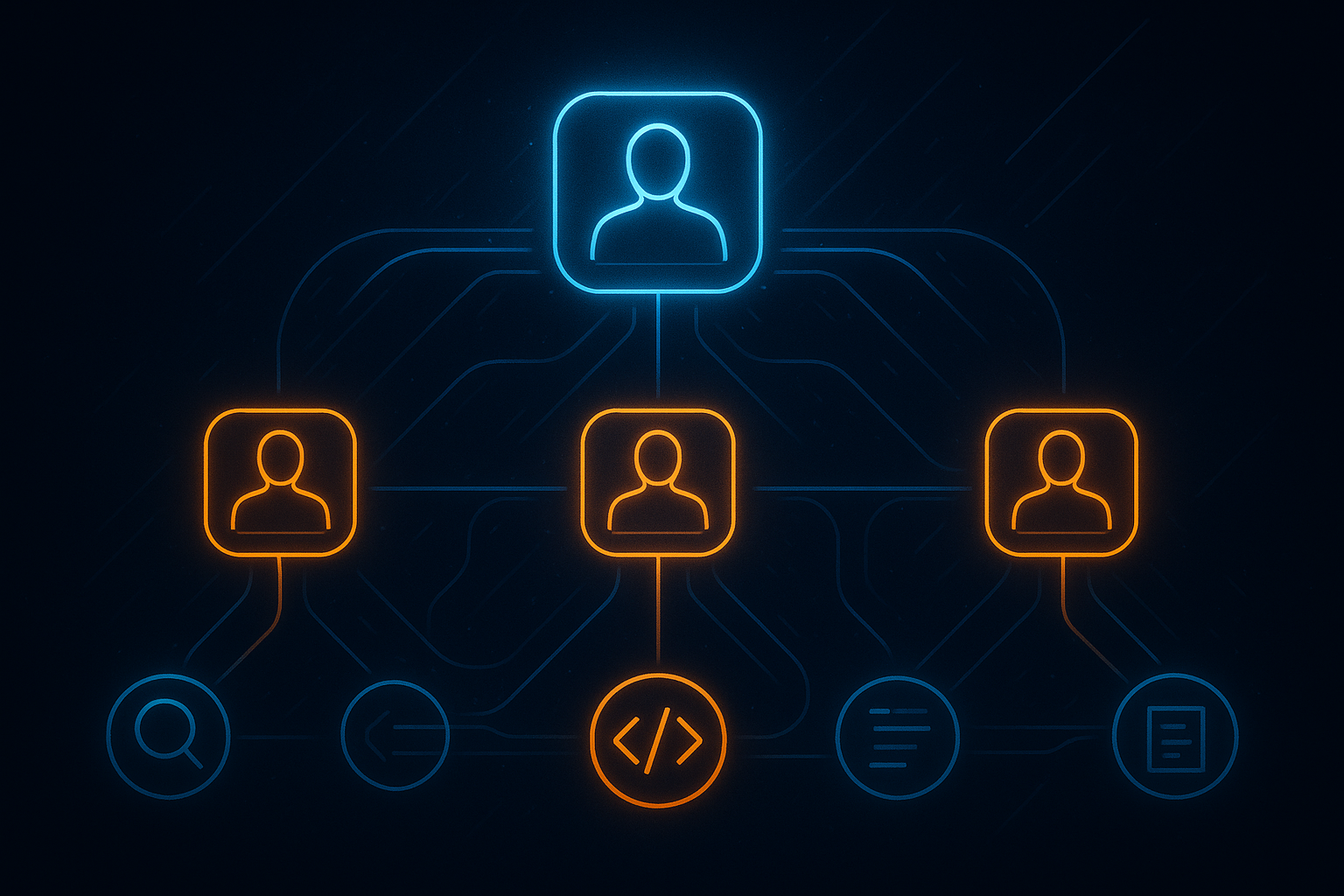
Forget the star topology where one mega-agent tries to do everything. The pattern winning in production is a supervisor-worker mesh: a lightweight orchestrator agent that holds task state and delegates to specialized sub-agents, each of which owns a narrow tool surface.
# Simplified supervisor-worker orchestration pattern
# Uses LangGraph-style state machine + MCP tool servers

from typing import TypedDict, Annotated, List
import operator

# --- Shared State Schema ---
class OrchestrationState(TypedDict):
    task: str
    plan: List[str]
    completed_steps: Annotated[List[str], operator.add]
    results: Annotated[List[dict], operator.add]
    errors: Annotated[List[str], operator.add]
    final_output: str

# --- Supervisor Node ---
def supervisor_node(state: OrchestrationState, llm, available_workers: list) -> dict:
    """
    Supervisor reads current state, decides which worker
    to invoke next, or declares completion.
    """
    system_prompt = f"""
    You are a task orchestrator. Available workers: {available_workers}.
    Current plan: {state['plan']}
    Completed: {state['completed_steps']}
    Results so far: {state['results']}

    Output JSON: {{"next_worker": "",
                   "instruction": ""}}
    """
    response = llm.invoke([
        {"role": "system", "content": system_prompt},
        {"role": "user", "content": f"Task: {state['task']}"}
    ])
    return parse_supervisor_response(response.content)

# --- Worker Node Factory ---
def make_worker_node(worker_name: str, tools: list, llm):
    """
    Returns a worker node bound to a specific tool set.
    Workers are stateless — they receive an instruction,
    call their tools, return a structured result.
    """
    def worker_node(state: OrchestrationState) -> dict:
        instruction = state.get("current_instruction", state["task"])

        # Worker uses ReAct loop internally
        result = run_react_loop(
            llm=llm,
            tools=tools,
            instruction=instruction,
            max_iterations=5  # hard cap prevents runaway loops
        )

        return {
            "completed_steps": [worker_name],
            "results": [{"worker": worker_name, "output": result}]
        }

    worker_node.__name__ = worker_name
    return worker_node

# --- Router: Supervisor decides next hop ---
def route_after_supervisor(state: OrchestrationState) -> str:
    next_worker = state.get("next_worker", "FINISH")
    if next_worker == "FINISH":
        return "finalize"
    return next_worker  # routes to named worker node

# Usage:
# workers = {
#   "researcher": make_worker_node("researcher", [web_search, doc_fetch], llm),
#   "coder": make_worker_node("coder", [code_exec, file_write], llm),
#   "reviewer": make_worker_node("reviewer", [lint_check, test_runner], llm),
# }
Notice what this pattern enforces: no worker can see another worker's tools. The researcher can't accidentally trigger a file write. The coder can't initiate a web request outside its sandbox. This is how you get the production safety properties you need without building a custom guardrails layer from scratch.
MCP Is the Glue — Use It Correctly
The reason tool orchestration is finally composable is MCP. But most teams are misusing it. They're wrapping every internal function as an MCP tool and wondering why their agents hallucinate tool names. Here's the rule: MCP servers should expose capabilities, not implementations.
// WRONG — too granular, agent gets lost in options
{
  "tools": [
    "db_connect", "db_query_select", "db_query_insert",
    "db_query_update", "db_close", "db_begin_transaction",
    "db_commit", "db_rollback"
  ]
}

// RIGHT — capability-level surface, implementation hidden
{
  "tools": [
    {
      "name": "query_customer_data",
      "description": "Read customer records matching criteria. Returns paginated JSON.",
      "inputSchema": {
        "type": "object",
        "properties": {
          "filter": {"type": "object"},
          "limit": {"type": "integer", "maximum": 100}
        }
      }
    },
    {
      "name": "update_customer_record",
      "description": "Update a single customer record by ID. Requires approval_token for PII fields.",
      "inputSchema": {
        "type": "object",
        "required": ["customer_id", "changes"],
        "properties": {
          "customer_id": {"type": "string"},
          "changes": {"type": "object"},
          "approval_token": {"type": "string"}
        }
      }
    }
  ]
}
See how the second version bakes in the approval gate pattern directly in the schema? The agent can't mutate PII without surfacing an approval_token field — which your orchestration layer intercepts and routes to a human. The tool schema is your policy layer. Design it that way from the start.
The Failure Mode Nobody Talks About: Context Rot
Here's what kills multi-agent systems in production that isn't in any tutorial: context rot. As agents pass state through a long chain, each hop adds tokens to the shared context. By step 8 of a 12-step pipeline, the orchestrator is reasoning over a 40k-token blob of intermediate results, half of which are irrelevant to the current decision.
The fix is aggressive state distillation at each supervisor checkpoint:
def distill_state_checkpoint(state: OrchestrationState, llm) -> OrchestrationState:
    """
    Called by supervisor before each routing decision.
    Compresses completed results into a dense summary.
    Prevents context window bloat across long pipelines.
    """
    if len(state["results"]) < 3:
        return state  # no distillation needed yet

    compression_prompt = """
    Summarize these intermediate agent results into a
    concise status update (max 200 words). Preserve:
    - Key outputs and artifacts produced
    - Blocking issues or errors
    - Current progress toward the original task
    Discard verbose reasoning traces.
    """

    compressed = llm.invoke([
        {"role": "system", "content": compression_prompt},
        {"role": "user", "content": str(state["results"])}
    ])

    return {
        **state,
        "results": [{"summary": compressed.content, "distilled_at_step": len(state["completed_steps"])}]
    }
Run this distillation every 3-4 completed steps. You'll cut orchestrator token consumption by 60-70% on long pipelines without losing task coherence. This is the kind of operational detail that separates demos from systems that run for weeks without drift.
What This Means for Your Stack This Quarter
Let me be direct about the practical implications. If you're building any kind of AI-assisted workflow today, you need to make three decisions immediately:
1. Pick your orchestration layer now. LangGraph vs raw LangChain is no longer an academic question — LangGraph's state machine model is the right primitive for supervisor-worker meshes. If you're building from scratch in 2026 and not using a graph-based orchestrator, you're going to rewrite it.
2. Instrument everything before you scale. Multi-agent systems fail silently. A sub-agent returns a plausible-looking but wrong result, the orchestrator accepts it, and the error propagates three steps before anything breaks visibly. You need span-level tracing on every tool call, every agent hop, every state mutation. Not nice-to-have — table stakes.
3. Design your human escalation paths now. The teams shipping multi-agent systems in regulated environments aren't removing humans — they're repositioning them. Humans review distilled checkpoints, approve high-stakes tool calls, and handle genuine ambiguity. The agent mesh handles volume. Get your escalation UX designed before you hit production load.
The Competitive Gap Is Opening Now
Here's the urgency: the teams building supervisor-worker meshes today are compressing 6-week engineering cycles into 3-day agent runs. They're not doing this perfectly — there are hallucinations, retries, occasional loops that hit the max-iteration guard. But they're shipping, and they're learning the failure modes. That learning is compounding.
The teams waiting for "more reliable" models or "better frameworks" are making a strategic mistake. The reliability is good enough now. The frameworks — LangGraph, CrewAI, AutoGen 2.0 — are stable enough for production. What's missing in most organizations isn't technology; it's the architectural knowledge of how to compose these systems safely.
You're reading the right site. Now go build the supervisor. Start with three workers — researcher, executor, reviewer. Wire them through a typed state schema. Add context distillation at step 3. Put an approval gate on anything that writes to production. Run it on one real workflow. The learning you get from that first real run is worth more than any amount of additional reading.
The window to be early on this is measured in months, not years. Move now.